The Aftermath Of An Unsustainable Diet. My Experience With Restrictive Dieting & Rebound.

This is my totally honest and open account of my experience with restrictive dieting, and not just the diet itself but the rebound from weeks and weeks of restriction.

Why am I sharing my experience?

The diet industry is a multibillion-pound industry with notably a very low success rate, and it’s not just because of weight-loss, because so many of us can actually lose weight, but because those who do manage to achieve weight loss gain it all back.

Weight regain or diet rebound statistics don’t leave for good reading, and not only do 60-70% people regain the weight back many people go on to gain more weight than when they started.

With obesity on the rise who helping these people who are actively trying to make a positive change to their health?

Why are these statistics not changing? Why is the diet industry failing people?

According to the British Nutrition Foundation 25% of men and 20% of women in the UK are considered obese, and a further 42% and 32% respectively were overweight according to BMI measurements. 

The diet industry is a money-making monster, and it’s seems common knowledge that diets in general have a very low success rate.

Which means the big winners here are the companies taking a slice of the billions spent by unsuspecting people simply trying to change their body because they aren’t happy with it.

Toxic companies selling quick fix fad diets endorsed by B list Love Island celebrities that do nothing other than harm to both our wallets and our mental and physical health.

I massively underestimated the fall out from a restrictive diet and what I thought would turn in to one day of eating what I wanted soon turned into an entire week and then rolled into two weeks before I managed to curb what felt like uncontrollable binging.

It was a few days after I had finished my transformation, I had a lightbulb moment and realised what was happening.

So this is why the diet industry is worth absolutely billions?

I’m getting a small taste of it and if I’m not careful il be another person contributing to the statistics.

Being a personal trainer and coach, I take pride in supporting people, there is nothing that fulfils me more than supporting people to a healthier more confident place.

And this experience albeit leaving me in tatters mentally, has completely opened my eyes to the struggles millions of us have each year.

It has been an invaluable learning experience for me and has done nothing other than reinforce my belief that food restriction of any form simply doesn’t work and can have a hugely detrimental impact on your mental health, how you feel about yourself and your confidence.

Restrictive dieting is damaging on so many levels, there is not long term

What is the solution?

Well, it’s not in the quick fix section in Holland & Barratt or last year’s Love Island Instagram page.

It requires a degree of knowledge, education, self-love, self-belief, discipline, and dedication to change.

Long term sustainability is key which means if you can’t wait for your diet to be over you are in trouble?

First, we must recognise that losing weight is really difficult, your body will aggressively defend its energy reserves at the first sign of weight loss.  

This doesn’t mean it’s impossible just a little harder, especially since you can get a McDonalds delivered to your door without moving nothing other than a finger.


A 3 Step Process to Healthy Eating

Is healthy eating difficult? Sure it is, there are so many factors that contribute to eating healthy. Our moods, energy levels, current cravings, hormones, the amount of sleep the previous night

Take this scenario; you have your weekly shop planned, however, you had a terrible night's sleep, you have woken up in not the greatest of moods, you have barely exercised all week and work has been crazy. 

How different do you think your food shop would be compared to a version of yourself after a great night's sleep, plenty of exercise, and a productive week at work.

I certainly cant influence most of the above factors but I can help you put in a system that will help you when it comes to decision making around food. 

I hope that by you practising this process and implementing this system regardless of external factors you'll stay on track with eating healthy and promoting good internal health.

Incredibly lockdown was announced 35 days ago, which means we are all eating still eating 3 meals per day at home and have constant access to the foods and drinks we are buying and have in our environment. 

Which makes our food shops more important than ever.

My 3-step process starts with a few basic questions I ask myself.

How many ingredients does this food contain? How many coloured fruits and vegetables make up my basket? Will eating this make me feel good about myself after?

I know my weaknesses, if I buy a pack of biscuits or chocolate if it’s in my environment aka my fridge or cupboard it’ll be eaten and very quickly and then, without doubt, they’ll be a feeling of guilt simply because I’m expending less energy in lockdown.

You don’t need 100% perfection but having a process or a few questions to ask yourself can help keep you on track to healthy eating and promoting good internal health.

If you can get to 80% of what you’re buying to include single ingredient whole foods, fruits and vegetables and then rather than buying say a packet of biscuits you could buy a single chocolate bar this way you can satisfy the craving without the guilt of looking at an empty bag of chocolates.

What do I mean by a single ingredient? A potato is a potato. An apple is just an apple. An organic free-range chicken should be just that, a chicken.

Much of our food now especially processed foods can contain high levels of synthetic chemicals, sugars, sweeteners, and stabilisers none of which your gut will thank you for.

Another really good habit to pick up is to check the ingredient list on the foods you buy and see what makes up the food you buy. The ingredients list of foods are listed in order of prominence with the ingredients used in the greatest amount first

Next, some valuable questions to ask when assessing how healthy your diet is.

Do my meals have an abundance of fruits and vegetables? How much of my diet includes single-ingredient foods? How much water am I drinking?

Implement the above and you’re giving yourself the best opportunity to consume foods that are high in antioxidants, anti-inflammatories and good sources of protein, fats, and carbohydrates. And guess what, you'll feel great.

Give it a go next time you’re writing your shopping list or preparing your next meal.

Recap:

3 Step Food Shop Process

How many ingredients does this food contain? How many coloured fruits and vegetables make up my basket? Will eating this make me feel good about myself after?

3 Step Meal Process

Do my meals have an abundance of fruits and vegetables? How much of my diet includes single-ingredient foods? How much water am I drinking?

Thanks 

Luke

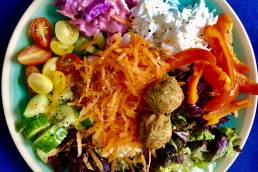
Ingredient List Of Meal Pictured: Lettuce, Radish, Pepper, 50g White Rice, Cucumber, Falafel, Celery, Red Cabbage, Carrot, Coleslaw (yoghurt, red cabbage, onion, carrot, white wine vinegar, salt, pepper)

Ingredients purchased and delivered by from Stroud Green Market. Check out what your local food market is doing during Covid-19.

Fat Loss Food For Real People Volume 4: Binge Eating!

Binge Eating. It’s the dirty little secret none of us like to admit we do. What I consider binge eating, and what you consider binge eating may be two different things, for me, and I am happy to openly admit it is something I struggle with, walking past an off license or somewhere that sells something of the chocolate variety, walking in making a purchase, for no particular reason, consuming and telling myself it’s okay I trained hard today. For me, that is binge eating and something I do FAR too often. For others it could be classed as eating late at night or going mad at the weekends having starved yourself Monday to Friday. Whatever it is, it is a behaviour many of us have.

There are probably multiple factors as to why you and I ‘binge eat’. You might actually not be eating enough throughout the day, you might not give a shit about the additional calories, or you might have a mild addiction to the feeling binge eating gives you for that very short period of time. Whatever it may be lets look at the most likely cause and what we can put in place to reduce the amount we 'binge'.

So what’s the deal with this uncontrollable desire?

Whether its drinking, eating, shopping, different binge behaviours actually have similar causes and unbeknown to us all there are a multitude of factors causing us to do so.

It’s definitely deeper than just eating something, our brains release a chemical called dopamine when we eat something that is palatable and tasty. And non-surprisingly it feels really good, so much so we do it again, and again until its becomes so ingrained in our behaviour we barely notice it. Unfortunately the same cannot be said for our waistlines.

Its this daily feel good hit of dopamine we essentially become addicted to. And looking at the bigger picture, it can be this small daily decision you're making that might also be inhibiting you from losing weight/fat if that is your goal. And if weight-loss/fat-loss is your goal then you shouldn't be consuming refined high fat high sugar foods anyway.

On top of this small feel good hit many of us have to deal with the daily stresses and pressures of life, providing for a family, working long hours, dealing with people in the office you cant stand the sight of. All of these factors can lead to behaviour that becomes harder and harder to control.

What can you put in place to help?

  1. Adequate calories. You might not actually be eating enough throughout the day. So have a look at your main meals and do they contain an adequate amount of protein. If you aren't consuming enough calories of lets say decent nutritious food the the likelihood of eating something high in fat and sugar will be higher.
  2. Breaking the habit! Try a different route that is less likely to take to past something you potentially might walk in. It sounds silly, but you might not even be aware of how habitual this behaviour has become and what triggers you.
  3. Make a better choice. Rather than buying something deemed unhealthy maybe buy some fruit. Pineapple or mango both taste sweet and might do the job of something wrapped or packaged.
  4. Stay disciplined. Find a reason as to why you want to prevent or reduce your current binge behaviour. Summer is almost here and with the recent heat wave I have already witnessed a mass panic. Use it to your advantage.
  5. Make a better decision. You don't have to walk far to find something free of something, gluten free, low calorie, vegan. Its out there and accessible find out a few options that will help you with whatever it is you want to achieve.

Indulging is fine and training hard certainly gives me more freedom with my food choices. Overindulging and sitting on your arse all day in and office though is not something I would recommend.

Ultimately like anything your level of discipline and adherence will be the determining factors but implementing the above might help you stay on the straight and narrow.

The Egg Explained

There is certainly a mythical stigma surrounding eggs and there supposed positive and negative benefits to our health. Fear not, the egg is our friend.

Eggs are a fantastic source of protein providing us with nutrients that help stimulate the brain, to easily digested amino acids and other vitamins that assist with our wellbeing.

Eggs have the second highest concentration of Leucine which is the most important amino acid for building muscle. Not only are they great for assisting in the building of muscle, the amino acid profile eggs contain aids in the preservation of promoting bone health.

Furthermore - they're cheap and readily available.