

How to Lose Your First 5–10lbs (Without Overcomplicating It)
If you want to drop your first 5 to 10lbs
This is for you.
Not a 12-week overhaul.Not a complete life reset.
Just a simple starting point that actually works.
Especially when you’re busy.Tired.And juggling a lot.
Because the truth is…
Most people aren’t failing because fat loss is complicated.They’re failing because they’re trying to follow things they can’t stick to.
So instead of another plan
Start here.
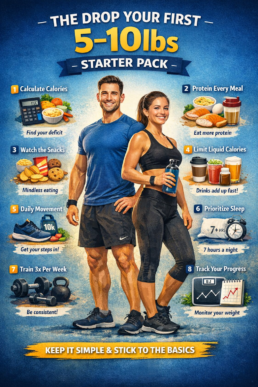
The ‘Drop Your First 5–10lbs’ Starter Pack
1. Structure your week properly
Before anything else, you need structure.
Read this:https://lukegoulden.com/onplanoffplansystem/
This is how you set your week up so you’re not relying on willpower.
Most people don’t have a fat loss problem.They have a structure problem.
2. Work out your maintenance calories
You need a rough idea of how much you should be eating.
You can use ChatGPT or an online calculator.Input your weight, height, gender, and activity level.
Or keep it simple:
Take your bodyweight (lbs) × 10 to 11
That gives you a solid starting range for a deficit.
Example:
- 220lb male → 2200 to 2420 calories
- 160lb female → 1600 to 1760 calories
Start there.Then adjust based on what actually happens over a couple of weeks.
3. Get protein in every meal
Most people massively under-eat protein.
This matters more than you think.
Higher protein intake helps you:
- Feel fuller
- Maintain muscle
- Improve body composition
If your meals are low in protein, fat loss will feel harder than it needs to.
4. Watch the snacking, grazing, and picking
This is where a lot of people get caught out.
Little bits here.A handful there.Something while cooking.Something after dinner.
Individually, they seem small.
But across a day?
They add up fast.
A few small extras can easily mean a few hundred extra calories.
Most people don’t even register it.
And this alone can wipe out your deficit.
5. Be aware of liquid calories
Liquid calories are easy to overlook.
- Coffees with extras
- Juices
- Smoothies
- Alcohol
They don’t fill you up in the same way food does.But they still count.
It’s very easy to add 300 to 800+ calories per day here without realising.
6. You might think you’re in a deficit… but you’re not
This is one of the biggest issues we see.
On paper, everything looks good.
But the extras tell a different story.
For example:
- Oil used in cooking → 150 to 200 calories
- A higher calorie latte → 100 to 150 calories
- Grabbing bits between meals → 200 to 400 calories
- Finishing the kids’ leftovers → 200 to 300 calories
That’s an extra 650 to 1,000+ calories.
Without a proper meal.Without much thought.
That’s the difference between:
Being in a deficitAnd sitting at maintenance (or above)
This is why people feel like they’re doing everything rightBut nothing is changing.
7. Be mindful of high-fat “healthy” foods
Healthy doesn’t mean low calorie.
Foods like:
- Nut butters
- Nuts
- Oils
- Avocado
Are great.
But they are also very calorie-dense.
A small pour of oil.A couple of extra spoonfuls.A handful of nuts.
That can quickly add a few hundred calories.
Awareness here goes a long way.
8. Stop skipping meals to “be good”
Skipping meals doesn’t fix anything.
It usually leads to:
- More hunger later
- Less control around food
- Overeating in the evening
Instead, build what an “on plan” day looks like.
Then repeat it.
Consistency beats restriction every time.
9. Move more every day
Daily movement is one of the most underrated fat loss tools.
It’s not flashy.But it works.
Aim for something like 8,000 to 10,000 steps per day.
Yes, it takes effort.Yes, it can feel like a chore.
Do it anyway.
10. Prioritise sleep
Sleep impacts everything.
EnergyHungerCravingsDecision making
Aim for at least 7 hours per night.
You’ll feel better.And you’ll make better choices.
11. Train consistently
You don’t need to train every day.
You don’t need to “go all in”.
Start with 3 sessions per week.
Done consistently, this is more than enough to see progress.
12. Track your bodyweight
If body fat dropsYour bodyweight will come down
Every time.
Tracking your weight gives you feedback.
Without it, you’re guessing.
13. Expect bad days (and handle them better)
They’re going to happen.
The key is your response.
One bad day doesn’t matter.
But letting it spill into the next day does.
And the next.
And the next.
That’s how a bad day turns into a bad month.
Break the cycle early.
14. Manage social situations better
You don’t need to go all in every time.
You don’t need:
Multiple coursesDrinks all nightFeeling rough the next day
Pick your moments.
Find some balance.
15. Bonus: Get help
Doing this alone is harder than it needs to be.
Having someone in your corner:
- Keeps you accountable
- Helps you stay consistent
- Guides you when things go off track
It makes a big difference.
How to actually apply this this week
Keep it simple:
- Work out your calories
- Plan 2–3 repeat meals
- Hit 3 training sessions
- Walk daily
- Track your bodyweight
That’s it.
Final thought
Most people read this and think:
“I know this”
But they’re not doing it consistently.
That’s the gap.
If you want help actually applying this
You can reach out here
Or just start with step one today.
That’s where it changes.
