Tips on how to reduce muscle soreness port workout…

Most of you at some point would have experienced that muscle soreness you get having worked out? Clambering out of bed, shuffling down the stairs, struggling to sit down at your desk the soreness hurts so bad.

Its called Delayed Onset of Muscular Soreness aka DOMS! Its generally a good indicator that you has trained hard enough in the gym. Most people will assume the soreness means they're getting stronger and bigger. It does make sense to think this, but its not always necessarily true. Research is somewhat murky surrounding DOMS and whether they're actually an indicator that we have trained hard enough.

Before moving on to what we can do to at least reduce the soreness lets look at some myths surrounding delayed onset of muscular soreness;

  • Genetics play a role
  • Eccentric Contractions will create more DOMS compared to the concentric contraction
  • Muscle soreness can be further aggravated by stress and sleep deprivation
  • The amount of soreness depends on the muscle being trained
  • Massage and Ice Baths are typically known for reducing DOMS. If they have any benefit its short lived and only an immediate cure
  • Static stretching will not reduce the likelihood of DOMS post workout

Caffeine

is known to already be a great pre workout stimulus and has benefits on both endurance and strength training. Its ability to reduce DOMS is a lot less unknown, but it does appear to be one of the most effective ways of reducing if not curing DOMS.Caffeine

Why: Scientists suggest that caffeine reduces muscular soreness because it blocks central nervous receptors related to pain.

Branch Chain Amino Acids (BCAA)

These little badboys are already known for their supposed ability to reduce muscle soreness and improve recovery.

Why: BCAAs increase protein synthesis and reduce muscle breakdown, conserving tissue during intense training. BCAAS preserves the integrity of the muscle fibers for less post-workout pain.

Warm Up

Warming up before starting your sets may lead to less soreness post workout. Before starting an actually set, do a couple warm up sets on a lighter load. Example if you're doing Chest Press. Do 3 or 4 warm up sets, 5 to 6 reps of a lighter load before start your actual set.

Why: Supposedly the initial training increases sarcomeres and causes adaptations in the inflammatory response. Then, the extra sarcomeres reduce the strain on muscle fibers during the second bout, leading to less muscle damage.

Hip Flexors

Do you work in an office? Suffer from lower back pain? Then the below information on what your Hip Flexors are, what they do and how the impact your daily life is a must read.

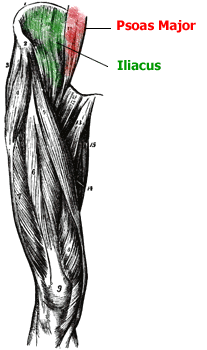
The 2 main muscles that make up the Hip Flexors;

  • Iliacus
  • Psoas

The main function of these muscles is too assist your joints in moving properly in their full range. They allow you to draw your leg to your torso, and also help move your legs from side to side and backwards.

The hip flexor is the muscle group that connects your legs to your torso and lower body, and allows your legs to move in conjunction with your torso. The hip flexor also serves to stabilise your hips and lower body, keeping the joints of your pelvis and lumbar spine strong.

If you spend most of the day in an office sitting down at a desk its more than likely your hip flexors will be underdeveloped, tight, stiff and short due to the static position they are kept in all day. You will more than likely experience a limited range of motion in the hips and lower back. That's because tight hip flexors pull your pelvis into an unnatural forward tilt, which in turn pulls your lumbar spine out of alignment, causing lower back pain.

Regular stretching and exercises that promote range of movement are great for increasing hip flexor mobility and strengthening (Lunges, Split Squats etc)