

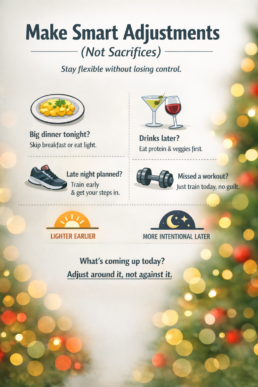
Your Holiday Survival Guide
Your Holiday Survival Guide
The holidays are busy.
Social plans multiply.
Food is everywhere.
This is usually where routines slip.
Training drops off.
Meals become reactive.
People write the whole period off.
“I’ll deal with it in January.”
“I’ll reset in the new year.”
“It’s only a few weeks.”
That thinking feels harmless in the moment.
Ideally, we want to avoid this way of thinking.
The aim isn’t perfection.
It’s control.
It’s about staying steady during the messiest weeks of the year so January feels like a continuation, not a rescue mission.
You don’t need to do everything.
You just need to keep doing something.
If anything, we want to be imperfectly consistent.
These six strategies are designed for real life, not ideal conditions.
- Eat Slowly. Stop at “Satisfied”
This is the simplest and most effective tool.
When you slow down, two things happen.
First, your body catches up.
It takes around 15 to 20 minutes for fullness signals to reach your brain.
If you eat fast, you overshoot.
Second, enjoyment increases.
You taste your food.
You feel content sooner.
You stop chasing that “too full” feeling.
This means you can enjoy festive meals without guilt or regret.
Try this at your next meal:
Put your fork down between bites.
Take a breath before going back in.
Finish feeling comfortable, not stuffed.
Ask yourself.
Did I enjoy that?
Or did I rush it?
- Short Workouts Still Count
December doesn’t need hours spent exercising, but you do need to do something.
Consistency matters more than intensity (one of my favourite quotes).
A few short workouts each week will:
Maintain strength
Protect habits
Support energy and mood
Even 20 to 30 minutes is better than the workout you didn’t do.
Let’s not get into the habit of “if I can’t do it all, then I won’t bother” or “I’ll wait for when I can.”
Remember, we do this more for our own mental wellbeing than anything.
Ask yourself.
What’s the minimum you can do between now and the new year and still feel like yourself?
Momentum is everything.
And it doesn’t take much to keep things ticking over.
- Plan for Eating on the Go
December is a killer for routines.
More travel.
More late nights.
More of that feeling of having no control over what you’re eating because you’re out or other people are cooking.
We might not always have control of what’s in front of us, but we always have control over what we put into our bodies.
That’s where decisions slip, because we sometimes tell ourselves we don’t have control when we do.
If you are away from home, think forwards by planning backwards.
Examples that work:
High-protein snacks or shakes in your bag
Simple, repeatable meals in the fridge
Go-to supermarket options you already trust
This stops the “I was starving, so I grabbed whatever” spiral.
You don’t need perfect meals.
You need repeatable and predictable ones.
Something we work on with all our clients.
Ask yourself.
What’s my default option when time is tight?
If you don’t know this, you should.
Get one or two options ready and practise the habit of turning to them first.
- Use Protein Shakes Strategically
Letting yourself get overly hungry is one of the fastest ways to lose control.
That’s when overeating happens.
That’s when drinks turn into snacks.
That’s when choices become reactive.
A protein shake acts as a buffer.
High protein.
Quick to consume.
Easy when life is chaotic.
Have one earlier in the day.
Between events.
Or before a big meal if you’ve barely eaten.
You’ll arrive calmer.
Less reactive.
More in control.
Ask yourself.
Where would one shake make today easier?
- Use Portion Awareness, Not Tracking
Tracking calories over Christmas rarely works.
Meals are mixed.
Portions are unclear.
Accuracy drops.
Instead, use portion awareness.
At main meals, aim for:
A solid protein portion
Some vegetables
A sensible amount of carbs or fats
Then enjoy the extras intentionally.
You don’t need restriction.
You need balance.
One heavier meal doesn’t matter.
Several days of mindless eating does.
Check in with yourself.
Is this a conscious choice?
Or am I on autopilot?
- Eat More Vegetables Than You Think You Need
Vegetables do a lot of work this time of year.
They support:
Fullness
Digestion
Energy
Mood
They make rich meals easier to handle.
The key is preparation.
Roast them.
Season them properly.
Use oils, herbs, and flavour.
They don’t need to be boring to be effective.
Anchor meals around them when you can.
Ask yourself.
Have I added anything today that helps me feel better?
The Big Picture
The holidays don’t ruin progress.
Abandoning structure does.
You don’t need extremes.
You need anchors.
Move your body regularly.
Eat with awareness.
Fuel yourself before hunger takes over.
If you can stay steady in December,
you can stay consistent any time of year.
